

For the lines and scars you've been re-treating year after year — a single filler built to hold its shape for five years or more, after a four-week skin test we won't skip.

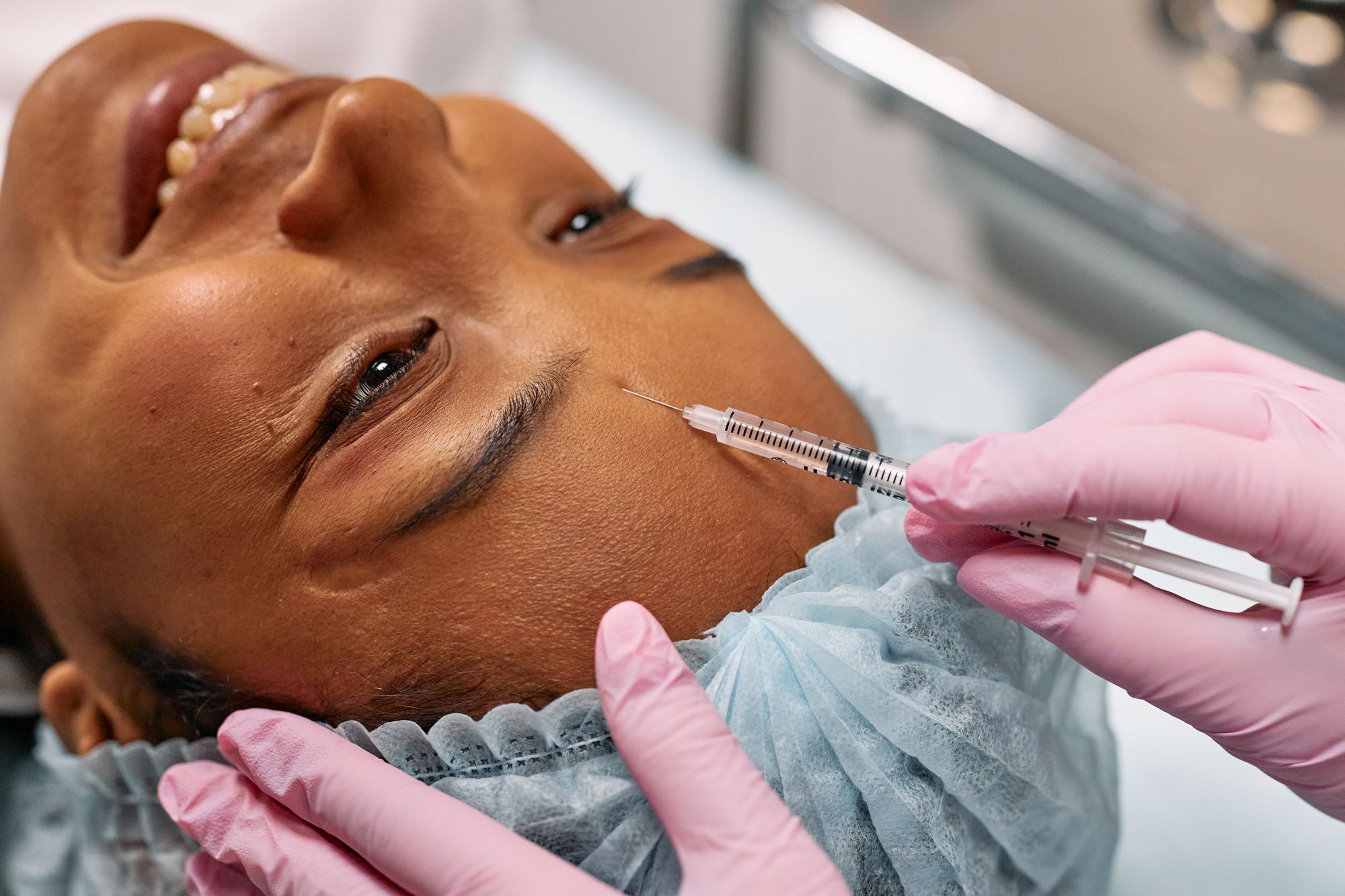
You leave the first visit with the line or scar already softer — that's the collagen gel doing its job. What you don't see is the scaffold we've placed underneath: microscopic PMMA microspheres your own collagen will weave into over the following weeks.
The gel resorbs. The scaffold stays. The correction you walked out with can still be there five years or more from now — meaningfully longer than any HA filler or biostimulator on the market.
The trade for that durability is a skin test four weeks before we treat — a tiny injection in the forearm, then a wait. We won't shortcut it, and we'll usually ask you to trial a reversible filler first so you know you love the look before you commit to keeping it.
Treated areas · Cheek acne scars · Nasolabial folds · Midface volume
Who it helps.
You'll see the change in the mirror the day we treat — and again in five years, when you haven't been back for a touch-up.
Most fillers ask you back every nine to eighteen months. Bellafill's microsphere scaffold is built to keep holding the correction five years and counting.
The collagen gel softens the line the moment we place it. Over the following weeks, your own collagen weaves into the scaffold and takes over.
FDA-cleared for the deep folds and the rolling acne scars HA filler can't really hold — placed only after a skin test we won't skip.
Bellafill is a long-commitment filler — these are the questions worth answering before the skin test, not after.
No. Bellafill's gel carrier is bovine collagen, and a small fraction of people react to it. The forearm test catches that before we ever place product in your face. It's a non-negotiable step — and the reason Bellafill has the safety record it does.
No — and that's the honest reason we usually ask you to trial a reversible HA filler like Restylane or RHA first. Once you know you love the look on you, Bellafill is how we make that look stay. PMMA microspheres are permanent.
The pivotal five-year FDA study showed durable correction for nasolabial folds, and a separate five-year trial confirmed it for rolling acne scars. Most patients see meaningful correction well beyond that window — your own collagen does much of the work after the first few months.
We use topical numbing and the product itself contains lidocaine. Expect pressure and a few quick pinches. Afterward — some swelling and the chance of a bruise for two to seven days. Most patients are back at work the next morning.
For rolling scars that flatten when you stretch the skin, yes — Bellafill is FDA-cleared and well-studied for exactly that pattern. Ice-pick and deep boxcar scars need different tools (often microneedling or laser resurfacing first). We'll tell you which scars are Bellafill scars at the consult.
A fair question, and part of why we're conservative with placement. Bellafill adds structural support in fixed planes — not the same as the volumizing arc HA filler creates. Built right and built modestly, it ages well; built aggressively, anything permanent can fight your face later. We err on the side of under-correction and layer over time.
Bellafill plans begin with a candid conversation about durability, the required skin test, and whether a reversible dermal filler trial should come first.

Plus: how we’d use a summer with the schedule on your side. One page, refreshed each month.
Read this month →