

A small draw at the start of your visit. An hour later, you leave with hollows softly filled — and weeks of quiet rebuilding still ahead.
It starts with a small blood draw — the kind you'd have at any annual physical. Your provider spins and gently warms it chairside, and within minutes you have your own platelet-rich fibrin gel: a soft, honey-like material rich in your own platelets, white cells, and growth factors.
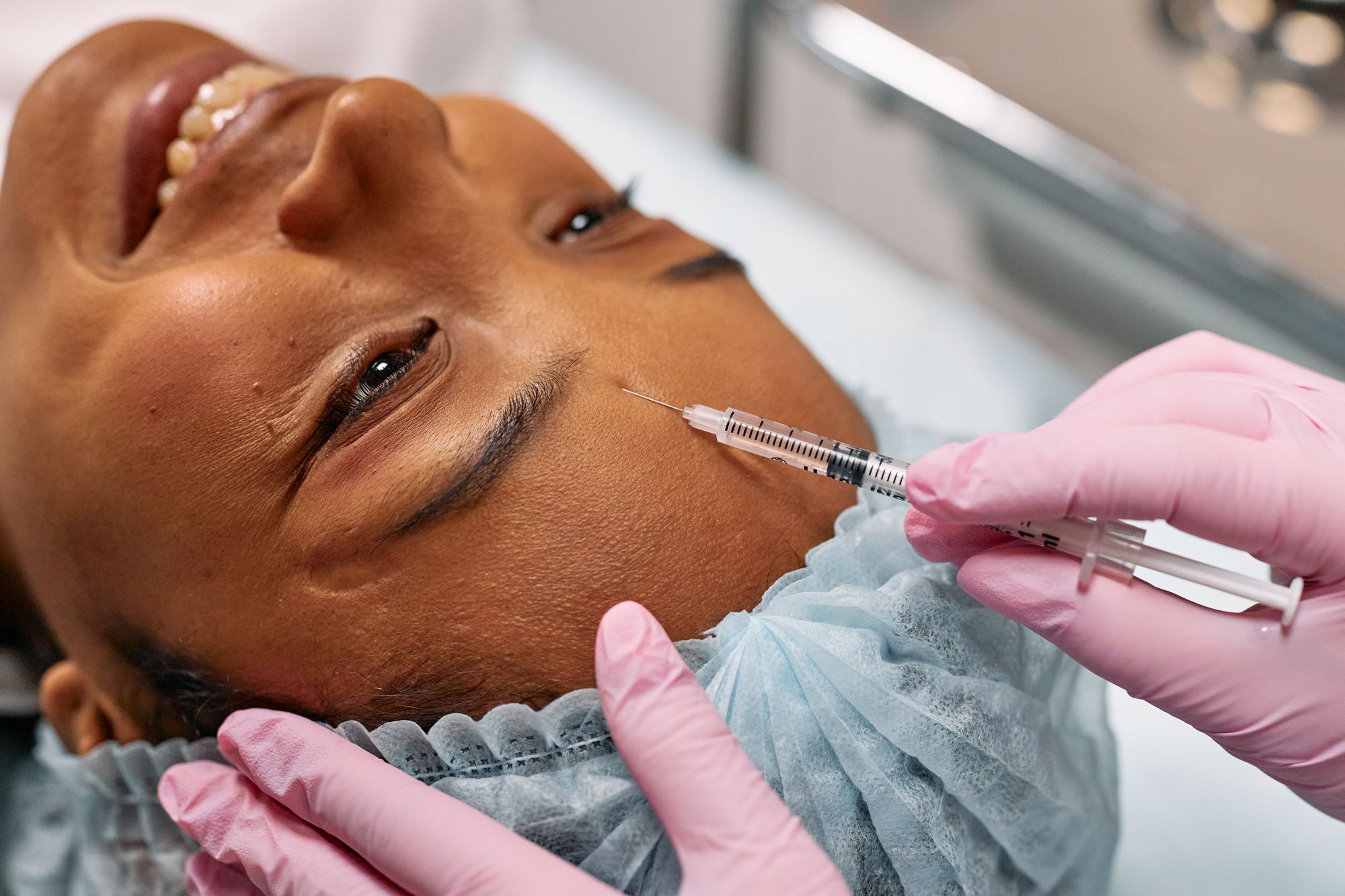
That gel is then placed precisely where you've lost softness — under the eyes, in the cheek, along the jaw. You see the volume right away. What you don't see is the quieter work: growth factors releasing over the weeks that follow, prompting your skin to repair and rebuild itself from the inside.
Patients often choose EZGEL when they want the look of a dermal filler with the regenerative signaling of PRF — and when they'd rather not put anything synthetic into their face at all.
Treated areas · Under-eye · Cheek & midface · Smile lines · Jawline · Lips · Acne scars
Who it helps.
Soft volume the day of — and skin that keeps quietly improving in the mirror for weeks afterward. Nothing in your face that didn't come out of your arm.
Hollows look softer the moment you stand up — no waiting weeks to know if it worked.
Your own growth factors release over the following weeks, so the surface quality often looks better at month two than it did walking out.
A natural option for patients who'd rather not introduce a manufactured filler — or who simply want to start there.
EZGEL sits between a filler and a regenerative — so most questions are about what that hybrid actually feels like, and how it compares to the synthetic option next door.
Yes — entirely. Your provider draws a small tube at the start of the visit, spins it in a chairside centrifuge, and gently warms the platelet-rich fibrin layer into a soft, honey-like gel. Nothing is added. What goes back into your face came out of your arm twenty minutes earlier.
An HA filler is a manufactured gel that holds volume mechanically — predictable, longer-lasting, reversible with an enzyme. EZGEL is your tissue: softer, more natural-feeling, and it sends regenerative signals to your skin while it's there. It doesn't last as long, and the lift is gentler — which is exactly why some patients prefer it.
You'll see softer hollows the moment you stand up — that's the gel doing its volumizing job. The regenerative change comes more quietly over the next four to eight weeks as growth factors release and your own collagen rebuilds. Many patients say the mirror looks better at week six than it did walking out.
Generally six to twelve months. The volume softens gradually as your body reabsorbs the fibrin matrix — but the collagen and tissue quality stimulated along the way tend to stick around longer than the gel itself.
Minimal. Expect mild swelling for a day or two and the possibility of a small bruise at the injection or draw site. Most patients are camera-ready inside 48 to 72 hours and can return to work the same afternoon.
It often is. Pairing EZGEL with microneedling or a resurfacing laser can amplify the regenerative signal — your provider will lay out the order so each visit builds on the one before, rather than competing with it.
EZGEL begins with a small blood draw in office — your provider then designs the placement around your facial architecture.

Plus: how we’d use a summer with the schedule on your side. One page, refreshed each month.
Read this month →